An Essay by Historian & Linguist Andrés Ehmann

The Dark Origins of
Nursery Rhymes

Nine nursery rhymes. What is their connection to three centuries of English history, including executions, religious wars and deposed kings?

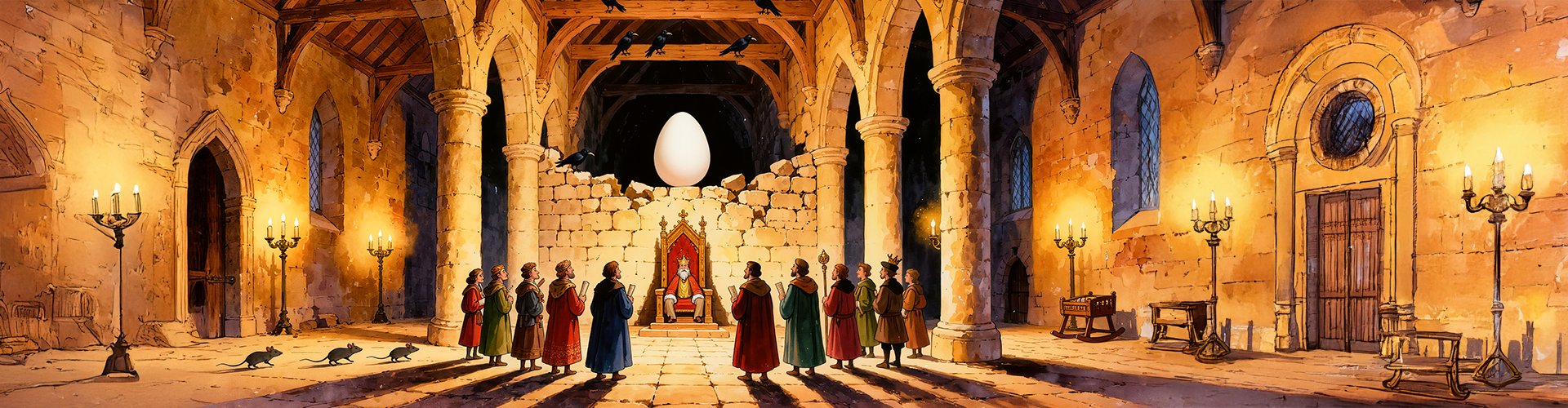
A dark, atmospheric illustration evoking the hidden histories behind nursery rhymes

Most people learn nursery rhymes as infants and never question them. Humpty Dumpty is a cheerful egg. Mary Mary tends her garden. Rock-a-Bye Baby is a lullaby. None of this, of course, is true.

Historian and linguist Andrés Ehmann explains the forgotten political meanings behind these seemingly innocent verses. His conclusion: nine of the most familiar nursery rhymes in the English language are coded records of royal scandal, religious persecution, and political upheaval, stretching from the court of Henry VIII (r. 1509–1547) to the final Jacobite rising in 1746.

This essay is the most comprehensive and coherent contextualisation of traditional nursery rhymes within English history.

Rock the Kings!

Chapter 1

Humpty Dumpty

The Defeat of Charles I, King of England and Scotland

Humpty Dumpty sat on a wall,
Humpty Dumpty had a great fall,
All the King's horses, and all the King's men
Couldn't put Humpty together again!

Listen to Humpty Dumpty →

Eggs in general don't become very famous very often, because they all look the same. In order to become famous there must be some distinguishing features. With eggs there are no distinguishing features — or, if we want to be as accurate as Humpty Dumpty himself, there are very few. We all know Humpty Dumpty, sitting on a wall and taking it for granted that he is the most famous egg on earth.

Humpty Dumpty is a very special case. Although he is famous, we know very little about him — perhaps even nothing. He is famous despite the fact that we know as much about his character as we do about any other egg. We don't even know when he appeared for the first time. We do know that he existed before 1862, the year Alice in Wonderland was published, because when Alice met him she already knew him:

…and when she had come close to it, she saw clearly that it was HUMPTY DUMPTY himself. "It can't be anybody else!" she said to herself. "I'm as certain of it, as if his name were written all over his face."

— Lewis Carroll, Through the Looking-Glass, Chapter Six

The only thing we know concerning his character is the fact that he had none. And that's not very nice! Despite being a characterless egg, according to Lewis Carroll, people are nothing but eggs.

"I shouldn't know you again if we did meet," Humpty Dumpty replied in a discontented tone, giving her one of his fingers to shake. "You're so exactly like other people."

"The face is what one goes by, generally," Alice remarked in a thoughtful tone.

"That's just what I complain of," said Humpty Dumpty. "Your face is the same as everybody has — the two eyes, so —" (marking their places in the air with his thumb) "nose in the middle, mouth under. It's always the same. Now if you had the two eyes on the same side of the nose, for instance — or the mouth at the top — that would be some help."

"It wouldn't look nice," Alice objected. But Humpty Dumpty only shut his eyes and said "Wait till you've tried."

— Lewis Carroll, Through the Looking-Glass, Chapter Six

Being an egg himself, he sees nothing but eggs. Have you ever thought about that? That an egg sees nothing but eggs? In other words, you see what you are.

It seems that Humpty Dumpty has been sitting on that wall for a long time, with no contact with the outside world. He doesn't even know that he is famous.

"Don't you think you'd be safer down on the ground?" Alice went on, not with any idea of making another riddle, but simply in her good-natured anxiety for the queer creature. "That wall is so very narrow!"

"What tremendously easy riddles you ask!" Humpty Dumpty growled out. "Of course I don't think so! Why, if ever I did fall off — which there's no chance of — but if I did —" Here he pursed his lips and looked so solemn and grand that Alice could hardly help laughing. "If I did fall," he went on, "the King has promised me — ah, you may turn pale, if you like! You didn't think I was going to say that, did you? The King has promised me — with his very own mouth — to — to —"

"To send all his horses and all his men," Alice interrupted, rather unwisely.

"Now I declare that's too bad!" Humpty Dumpty cried, breaking into a sudden passion. "You've been listening at doors — and behind trees — and down chimneys — or you couldn't have known it!"

"I haven't, indeed!" Alice said very gently. "It's in a book."

— Lewis Carroll, Through the Looking-Glass, Chapter Six

What Humpty Dumpty doesn't want to know (although he knows it) and what Alice doesn't want to tell him (although she knows it) is that the king will not be able to put him together again. So this special and very famous egg, perhaps like all eggs, sees what he is, but ignores what he doesn't want to know.

Some of Humpty Dumpty's ideas are not so bad. It would of course be much more rewarding to celebrate the non-birthdays (364 gifts, one for each non-birthday) rather than the one birthday a year. His other conclusions are more tenuous:

"When I use a word," Humpty Dumpty said in rather a scornful tone, "it means just what I choose it to mean — neither more nor less."

"The question is," said Alice, "whether you can make words mean so many different things."

"The question is," said Humpty Dumpty, "which is to be master — that's all."

— Lewis Carroll, Through the Looking-Glass, Chapter Six

In theory, why not? But how would one communicate if everyone gave different meanings to words? We are talking about an egg, and an egg doesn't have individual emotions, feelings, or experiences to put into words.

One final problem, perhaps the largest, remains unresolved. Who is Humpty Dumpty? You could say an egg. That's true, but has he always been an egg or did he become an egg in the course of history? Some people say Humpty Dumpty was initially a cannon and later became an egg — and that's when the historical context of the song was lost. Let's have another look at the text:

Humpti Dumpti sat on a wall,
Humpti Dumpti had a great fall;
Threescore men and threescore more,
Cannot place Humpty Dumpty as he was before.

We know the lyrics of songs are often changed to fit a certain historical event. "Threescore men" became "All the King's men", which suggests there was a particular reason for the change. What was the event in history where Humpty Dumpty had a relationship to the king, his men and his horses?

There are many who establish a relationship between this song and the English Civil War of 1642 to 1649, which ended with the execution of Charles I, King of England and Scotland, and the seizure of power by Oliver Cromwell. Following this theory, a cannon named Humpty Dumpty — one which actually existed — was placed on the tower of a church in Colchester (south-east of England) by the troops of Charles I, from where they fired on the Roundheads, Cromwell's Parliamentary army under Lord Fairfax. In order to stop the bombardment, the Roundheads fired back and succeeded in knocking the cannon from the tower. Neither the king's men nor the king's horses were able to haul it back into position.

A second theory suggests that Charles I was Humpty Dumpty himself. After finally losing the war, he was executed despite all his men and horses. These, however, can only be theories, with no actual proof in existence.

What arguments support these theories? First: we know for certain that the text was changed. "Threescore men and threescore more" became "All the King's horses and all the King's men". It is likely that the original was altered to better fit the circumstances of the time. Second: as we can see throughout this collection, there are many songs dealing with the reigns of Henry VIII, Mary I, James I, Charles I, Charles II and James II. In the insecure political, social and religious climate of those years, people expressed their opinions by producing new songs or changing existing ones. Third: Humpty Dumpty is a good example of a song that developed complexity over time. When Lewis Carroll heard it, it was just a nursery rhyme about an egg. By Chapter Six of Through the Looking-Glass, Humpty Dumpty had become a complex philosophical figure. We can see how easily a song can change its meaning and become independent from its original context. It may well have been a riddle first, and only later adopted to mock Charles I.

Chapter 2

Georgie Porgie

Charles II and Oliver Cromwell

Georgie Porgie, pudding and pie,
Kissed the girls and made them cry,
When the boys came out to play,
Georgie Porgie ran away.

Listen to Georgie Porgie →

Although not unequivocally linked to a specific historical event, this is another nursery rhyme with a clear historical background. The song tells a story, and the story is not flattering:

Georgie Porgie, pudding and pie — It seems that Georgie Porgie, whoever he is, may be overweight because he eats too much pudding and pie.

Kissed the girls and made them cry — He promised a great deal to girls, but never kept his promises — or was simply unattractive to them.

When the boys came out to play — For unspecified reasons he got into trouble with other boys.

Georgie Porgie ran away — When any conflict arose, he preferred to run. In other words, he is a coward.

We can therefore assume Georgie Porgie is an immoral figure: lazy, despicable, greedy and cowardly.

It is well known that writers from various cultures like to use myth, history or song to give deeper meaning to their work. Christian and Greek mythology, and even fairy tales, are often employed by writers for similar purposes.

In Rudyard Kipling's short story Georgie Porgie, he is an army officer serving in Lower Burma. The name was adopted as a joke — in the local tongue, it resembled the words for "puff, puff, puff, great steamboat!" — a considerable social demotion for the man concerned. Kipling's Georgie Porgie "marries" a Burmese girl who is everything he is not: beautiful, romantic, sensitive and honest. He then abandons her to marry an English woman. The ending is deliberately ambiguous:

The Bride and the Bridegroom came out into the verandah after dinner... "What is that noise down there?" said the Bride. "Oh," said Georgie Porgie, "I suppose some brute of a hillman has been beating his wife." But it was Georgina crying, all by herself, down the hillside, among the stones of the water-course where the washermen wash the clothes.

— Rudyard Kipling, Georgie Porgie

Roald Dahl also used the name Georgie Porgie for the protagonist of a tale in his 1960 collection Kiss Kiss — a man obsessed with the terror of being swallowed when kissed by a woman. When it actually happens, he goes mad and is committed to a lunatic asylum. Perhaps weak and cowardly characters get "lost" if they kiss too much. In any case, a song from the seventeenth century has been given a very modern interpretation by Roald Dahl.

A modified version appears in Chapter Five of Brave New World by Aldous Huxley:

"Orgy-porgy, Ford and fun,
Kiss the girls and make them One.
Boys at one with girls at peace;
Orgy-porgy gives release."

— Aldous Huxley, Brave New World, Chapter Five

Georgie has been changed to "orgy". In the context of Huxley's novel, the twelve participants are celebrating a session to honour the Greater Being — Ford, as in Henry Ford, representative of a world in which consumer desires are satisfied or manipulated, and mass production becomes a kind of religion. In "becoming One", the participants lose all individuality, and if there is no individuality, being alive or dead makes no great difference.

The most radical change is in the second line. In the original, Georgie Porgie kisses different girls, each an individual. In Huxley's version there is no difference between "them" — they have, along with the boys, abandoned their character entirely. This is a well-known phenomenon: fairy tales, myths, songs from the collective consciousness are very often given entirely new meanings.

There is also a second, possibly older, version of the song:

Rowley Powley, pudding and pie,
Kissed the girls and made them cry;
When the girls began to cry,
Rowley Powley runs away.

It is unknown which version is the original. "Rowley Powley" equally suggests someone round — fitting well with someone who eats too much pudding and pie. The change from "when the girls began to cry" to "when the boys came out to play" arguably fits better with a specific political situation.

There are three historical candidates for Georgie Porgie: George Villiers (1st Duke of Buckingham), Charles II, and George I.

George I was the first Hanoverian — a German blood relative of Queen Anne, the last Stuart monarch. More importantly, he was not Catholic. In those days, being Catholic was considered even worse than being German.

George Villiers (1592–1628) rose to extraordinary influence during the reigns of James I and Charles I, not through political or diplomatic skill, but through a very close personal friendship with both kings — a relationship rumoured to be sexual. His name, and the fact that he really did "run away" when his poorly prepared military campaigns ended in disaster, make him a plausible candidate. On the other hand, the verse "Georgie Porgie, pudding and pie" doesn't fit perfectly, because Villiers was not particularly overweight. He was supposedly very handsome — at least in the eyes of James I.

The better candidate is probably Charles II. Whether he was really fat is hard to say, but he certainly doesn't look like a Greek athlete. The line "Kissed the girls and made them cry" fits very, very well — if you look at the Wikipedia article about him, you will find that a substantial portion of it deals with his mistresses. He had at least twelve illegitimate children. He was also known as the Merrie Monarch.

The lines "When the boys came out to play / Georgie Porgie ran away" also fit well, because he fled repeatedly from "the boys" — the troops of Oliver Cromwell — to France or the Netherlands. After his forces were defeated at the Battle of Worcester in 1651, he avoided capture by hiding in an oak tree. A king hiding in a tree is, it has to be said, a fairly definitive form of running away.

Chapter 3

Three Blind Mice

Queen Mary I and the Persecution of English Protestants

Three blind mice, three blind mice,
See how they run, see how they run!
They all ran after the farmer's wife,
Who cut off their tails with a carving knife.
Did you ever see such a thing in your life
As three blind mice?

Listen to Three Blind Mice →

This nursery rhyme is often said to be about Mary I (1516–1558), daughter of Henry VIII and Catherine of Aragon, who was declared "illegitimate" when her father married Anne Boleyn. She nevertheless became Queen of England when her half-brother Edward VI, son of Henry VIII and his third wife Jane Seymour, died. If this theory is correct, the song is most likely about religious persecution — specifically, the persecution of Protestants by a Catholic queen. (There are also songs linked to the persecution of Catholics by Anglican kings — Little Jack Horner and Goosey Goosey Gander among them. Religious persecution in the sixteenth century was evidently a productive source of material.)

A possibly different version appears in a book edited by Thomas Ravenscroft in 1609:

Three Blinde Mice, three Blinde Mice,
Dame Iulian, Dame Iulian,
the Miller and his merry olde Wife,
she scrapte her tripe licke thou the knife.

It is hard to say which version is the original. If the better-known version is about the persecution of Protestants, it may have made sense to change the text when the Protestant Elizabeth I ascended the throne after her half-sister. The sardonic tone of the song can in any case be explained by a century of religious persecution in England. First the Protestants were persecuted under Henry VIII. Then the Catholics were persecuted under Henry VIII (the order, one notices, stayed the same for the Catholics but reversed for the Protestants). Then the Catholics persecuted the Protestants under Mary I. Eventually this led to everybody persecuting each other during the reigns of Charles I, Charles II and James II. The big difference between England and other countries is that in England this type of song survived. In Germany, for instance, there are no songs from the Thirty Years' War (1618–1648), although they once existed.

The historical background, if we accept the theory, is as follows:

Mary I (1516–1558) was the daughter of Henry VIII (1491–1547) and his first wife, Catherine of Aragon (1485–1536). When Henry VIII wanted to divorce Catherine to marry Anne Boleyn (1501–1536), he required papal permission — which the Pope refused. When Anne Boleyn became pregnant in 1533, Henry declared himself Supreme Head of the Church of England, severing it from Rome, and the Pope's approval became irrelevant. This decision had two lasting consequences. The Church of England became, and still is, independent from Rome. The second was that Mary became illegitimate, because her parents' marriage was declared invalid on the grounds that Catherine had previously been married to Henry's brother Arthur.

Henry's hopes that Anne Boleyn would produce a son came to nothing. Her first child was a girl — the future Elizabeth I — and subsequent pregnancies ended in miscarriage or stillbirth. Anne Boleyn was accused of adultery and executed. Only the third marriage, to Jane Seymour (1508–1537), produced the desired son, Edward; but Jane died two days after the birth.

Edward (1537–1553) became Edward VI in 1547. Under him, clerical celibacy was abolished and the Mass was conducted in English rather than Latin. (For a fifteen-year-old boy, he had some remarkably theological interests.) He died without an heir. His attempt to exclude Catholics from the succession by crowning his Protestant cousin Lady Jane Grey was not accepted, and Mary I became Queen of England. She reversed the Protestant reforms of Edward, and England became Catholic once more — until the Elizabethan Religious Settlement of 1559 reversed it again.

To understand the severity of the persecution that followed, it is important to note that Mary I married Philip II of Spain (1527–1598) in 1554. Spain was perhaps the most fervently Catholic nation of the time — the Grand Inquisitor Tomás de Torquemada had died only fifty years earlier. Philip II did intervene in the persecutions, though his adviser Alfonso de Castro warned him that such measures could generate strong anti-Spanish feeling among the English. Part of the subsequent conflict between England and Spain, and the strong anti-Catholic movement of the following century, can be explained by these persecutions — which were so bloody that Mary I became known to history, and to popular song, as Bloody Mary.

If we accept this theory, the three blind mice were Protestants who opposed the policies of Mary and Philip (they all ran after the farmer's wife). They were subsequently destroyed, killed, or stripped of their position (who cut off their tails with a carving knife). The reference to "farmer's wife" may be explained by Philip II's large landholdings — though one might also observe that it was simply a convenient rhyme.

Chapter 4

Rock-a-Bye Baby

The Fall of James II and the Glorious Revolution

Rock-a-bye baby, on the treetop,
When the wind blows, the cradle will rock,
When the bough breaks, the cradle will fall,
And down will come baby, cradle and all.

Listen to Rock-a-Bye Baby →

This nursery rhyme contains a genuine philosophical question — perhaps one of the most important questions in philosophy. The question is: do words matter?

You can read everywhere, and there is no doubt that the rhyme is used in this way, that this is a lullaby, sung to help children fall asleep. It would seem, however, that neither the baby nor the adult singing the song is particularly aware of what they are actually singing. Concerning the baby, this is not very surprising. If they are young, words like "treetop", "bough" or "cradle" would have no meaning for them. Concerning the adult, the situation is more complicated. He or she understands exactly what the song is about.

Because, if the baby understood what was being sung, the baby would be shocked. The song is about a cradle rocking on a treetop. In order to fasten a cradle there, the treetop must be of a certain size — the tree must be at least five metres tall. If the bough breaks, it must be a strong bough on a strong tree, otherwise it would merely bend. We can therefore assume that the baby would fall at least five metres. Sweet dreams would seem unlikely. A nightmare would be more probable.

Words, when they first appear in history, have a specific meaning. But after that, they become a box into which people put their emotions and ideas — often very strange ones. When the word "love" first appeared in history, it had a meaning; but then it became a box into which people put everything they associated with it. We can therefore assume that a long time ago this song had a concrete meaning. Let's look at what that might have been.

The description is abstract, but it contains a great deal of information. The baby is in a very high but insecure position. This position is endangered because a wind may start to blow, which will rock the cradle and break the bough, and the cradle will fall. The most important word is at the end: not only the baby and the cradle will fall, but "all". What is "all"?

There are three reasons to believe this song refers to the Glorious Revolution — the overthrow of James II, the last ruling Stuart king.

First: this argument applies to all songs with a historical background. The only alternative is to say they mean nothing. But words, as we have established, become boxes over time; when they start their lives, they have a meaning.

Second: there are many songs in which the relationship to the House of Stuart can be easily established. Very few songs with a historical context do not refer, directly or indirectly, to the Stuarts.

Third: the abstract but detailed description fits very well with a specific historical situation.

We have already seen in Humpty Dumpty, Georgie Porgie and Three Blind Mice that the sixteenth and seventeenth centuries were characterised by religious conflicts overlaying other interests. When Henry VIII declared himself head of the English Church in 1533 to marry Anne Boleyn, the Catholics were persecuted. This was both financially interesting — the expropriation of Catholic monasteries being good financial business — and theologically convenient, since the Catholic Church was opposed to his divorce from Catherine of Aragon. After the death of Henry VIII, his son Edward VI ascended the throne and reformed the Church further. After his early death, his half-sister Bloody Mary reversed those reforms. When Mary I died, Elizabeth ascended the throne and the Anglican Church became the official Church of England. There are no surviving songs about the conflict between Mary Stuart and Elizabeth I, although that conflict, besides the struggle for power, also had a religious dimension.

After Elizabeth, three more kings separate us from the historical situation described in the song. James I (1566–1625), son of Mary Stuart, was followed by Charles I (1600–1649), then Charles II — and then, finally, James II and his precarious infant in the treetop.

The relationship between Charles I and Parliament was difficult from the start — his marriage to the Catholic Henrietta Maria de Bourbon, the destabilising influence of George Villiers (see Chapter 2), and riots in Scotland and Ireland all combined to force him to ask Parliament for money he could not extract any other way. Parliament was broadly in favour of suppressing the Irish rebellion but feared that the power acquired through that money would afterwards be used against them. Charles I's attempt to arrest the parliamentary leader Pym was considered a coup d'état and triggered the first Civil War (1642–1645) and second Civil War (1647–1649), which ended with the execution of Charles I. England became a republic, briefly, with Oliver Cromwell as Lord Protector.

Cromwell's wars against Scotland and Ireland and his suppression of Catholicism eventually made him deeply unpopular. For this reason, Parliament restored Charles II (1630–1685), son of Charles I, as King following Cromwell's death in 1658. We have already met Charles II. Although he had a very exciting, if rather eventful, personal life and a considerable number of children (that's what we assume — we trust they were nice), he had no legitimate son or daughter. And so his younger brother — yes, we have arrived at the cradle falling from the top of the tree — James II ascended the throne of England.

The Stuarts were not what one would call a success story, but in history everything is relative. James II (1633–1701), like his brother, had spent years in exile in France during Cromwell's rule — serving first in the French army during the Franco-Spanish War (1650–1653) and then, with admirable flexibility, in the Spanish army against France. He returned to England in 1660 when Charles II became king.

James converted to Catholicism, though nobody quite knows why. Perhaps during his time in France and Spain he visited too many churches instead of sampling the local food and wine and enjoying himself. Some people do go slightly mad thinking too much about the eternal questions. In any case, he not only converted but made it public — and under his rule the discrimination against Catholics in public life was gradually abolished, to the intense suspicion of Parliament, who feared the re-Catholicisation of England and the renewed influence of Spain and France.

James married twice. His first wife, Anne Hyde (1638–1671), produced two Protestant daughters: Mary (1662–1695), who married William of Orange, and Anne (1665–1714), who would become Queen after William III. His second wife, Mary of Modena (1658–1718), whom he married in 1673 when she was fifteen, strengthened his commitment to Catholicism considerably.

After James ascended the throne in 1685, several isolated attempts were made to remove him. But it was in 1688, when Mary of Modena gave birth to a son — James Francis Edward (1688–1766), the future Old Pretender — that fears became acute. With a Catholic male heir, the danger of permanent re-Catholicisation seemed imminent. Protestants circulated the rumour that the child was not Mary's at all, but had been smuggled into her chamber in a warming pan to substitute for a stillborn infant. It is now certain the rumour was entirely false, but it served its political purpose.

Rock-a-bye baby, on the treetop / When the wind blows, the cradle will rock — James Francis Edward's entire position was insecure. The whole of society is the tree upon which any king must rely, and his position at the top was unstable. A little wind was enough to make him fall, and with him, the entire House of Stuart.

The birth of James Francis Edward was the final event that broke the bough. In 1688, the very year of that birth, Parliament invited William of Orange (who had, conveniently, married Mary, the Protestant daughter of James II by his first marriage) to invade England and overthrow James. William arrived with his troops on 5 November 1688. Most of James's officers defected. James fled to his cousin Louis XIV of France. There is no doubt: the baby, the cradle, and all came down from the treetop.

It's worth noting how often traditional songs are changed to fit a different context. From this one, for instance, there exists another version that describes the desperate situation of the labouring poor at the beginning of the Industrial Revolution:

Hush-a-bye baby, on the tree top,
When you grow old, your wages will stop,
When you have spent the little you made,
First to the poorhouse and then to the grave.

The topic is completely different. The sardonic tone remains exactly the same.

Chapter 5

Jack and Jill

The French Revolution

Jack and Jill went up the hill
To fetch a pail of water.
Jack fell down and broke his crown,
And Jill came tumbling after.

Listen to Jack and Jill →

It is widely asserted that this nursery rhyme is connected to the French Revolution — more precisely, to the execution of the French King Louis XVI on 21 January 1793 (Jack fell down and broke his crown) and his wife, Marie Antoinette, nine months later on 16 October 1793 (and Jill came tumbling after).

This theory can only be correct if the commonly cited first publication date of 1765 is wrong, and the actual date was closer to 1795. There do seem to be differing opinions about the publication date of both the music and the lyrics.

Obviously, it is very hard to believe that a song about the execution of Louis XVI could have been written before Louis XVI was actually beheaded. Nevertheless, the theory cannot be entirely excluded given the discrepancy in dates. And in favour of the French Revolution theory, there is at least one other song that very clearly deals with the execution of the French king:

King Louis was the King of France
Before the Revolution,
Way, haul away, we'll haul away Joe,
King Louis got his head cut off
Which spoiled his constitution.
Way, haul away, we'll haul away Joe.

Haul Away Joe (traditional sea shanty)

Although this song was later mixed with other verses about wholly unrelated matters, there is no doubt that this section of it deals with the French Revolution. The fact that one contemporary song dealt openly with the execution of Louis XVI makes it at least plausible that another, less explicit, song might have done the same — particularly if one accepts the later publication date for Jack and Jill.

Chapter 6

Sing a Song of Sixpence

Henry VIII and the Dissolution of the Monasteries

Sing a song of sixpence,
A pocket full of rye,
Four and twenty blackbirds
Baked in a pie.
When the pie was opened
The birds began to sing;
Wasn't that a dainty dish
To set before a king?

The king was in his counting house
Counting out his money,
The queen was in the parlour
Eating bread and honey,
The maid was in the garden
Hanging out the clothes,
When down came a blackbird
And pecked off her nose!

Listen to Sing a Song of Sixpence →

There are many stories that people read and hear every day and take for facts, although they are nothing but fiction — and many interpretations of nursery rhymes that have only the loosest relationship to actual historical evidence. But what would be the alternative? To say that the texts are nonsense, that they have always been nonsense? Is that really more plausible than saying there was a meaning that got lost in the course of history? And if one thinks it is more plausible, how do you explain why these apparent absurdities survived for centuries? Nonsense is generally eliminated quickly.

As with other nursery rhymes, there are several interpretations of this song. One possibility is a relationship to the dissolution of the monasteries under Henry VIII. In this case, the blackbirds would be monks or priests — who were generally dressed in black — who began to sing (a sardonic way of saying they cried out) when the pie, representing the monasteries, was opened and consumed — that is, absorbed into the king's estate. If we interpret it that way, the question "Wasn't that a dainty dish to set before a king?" becomes pointed rather than innocent.

What arguments can be made for this interpretation? The most convincing is the fact that there are many songs about the dissolution and destruction of the monasteries under Henry VIII — among them Goosey Goosey Gander, Little Jack Horner, and Little Boy Blue. The idea of something hidden inside a pie is also used in Little Jack Horner:

Little Jack Horner
Sat in the corner
Eating his Christmas pie,
He stuck in his thumb
And pulled out a plum.

In that case, the "plum" pulled out was the title deed to the Manor of Mells, one of the largest Catholic monasteries. If we have two different songs and one of them shows strong evidence of a connection to the dissolution of the monasteries, alongside a recurring image of a pie containing something concealed, it is not entirely implausible that both songs refer to the same historical event.

The image of something hidden in a pie is also historically plausible for another reason: there are recipes from this period describing how to conceal live birds inside a hollowed-out cake or pie. There is even a record from the wedding of Marie de Medici and Henry IV of France in which birds were hidden inside a pie and flew away when it was cut.

Wikipedia dismisses the monastic theory on the grounds that the earliest known version mentions "naughty boys" rather than blackbirds:

Sing a Song of Sixpence,
A bag full of rye,
Four and twenty naughty boys,
Baked in a pie.

But this substitution changes nothing essential. By the time of the dissolution of the Catholic monasteries and the general persecution of Catholics, it was perfectly possible to view monks as "naughty boys". General attitudes towards Catholics in certain parts of society were strongly negative, as the song Goosey Goosey Gander makes very clear.

As for the second verse — the king was undoubtedly in his counting house counting out his money. He had declared himself head of the Church of England not only because he wanted to marry Anne Boleyn, but also because he wanted to resolve his chronic financial problems by expropriating the Church's assets. Having done so, it is very likely that he counted his gains. The queen, meanwhile — Catherine of Aragon — could eat bread and honey and live well, because without the Pope's consent, Anne Boleyn, who was actually Catherine's maid of honour, could not legally marry Henry. Indeed, the first tentative steps of Henry VIII to marry Anne Boleyn failed — because one blackbird, the Pope himself, declined to cooperate.

Chapter 7

Mary Mary Quite Contrary

"Bloody Mary" — Queen Mary I

Mary Mary quite contrary,
How does your garden grow?
With silver bells and cockle shells
And pretty maids all in a row.

Listen to Mary Mary Quite Contrary →

There are different interpretations of this nursery rhyme, but most of them place Mary I — Bloody Mary — at the centre. The historical context was explained in Chapter 3. To briefly recap: Mary I (1516–1558) was the daughter of Henry VIII and his first wife, Catherine of Aragon. When Henry VIII divorced Catherine to marry Anne Boleyn, Mary became "illegitimate" and was no longer heir to the throne. After the death of Henry VIII, his son from his third marriage, Edward VI, briefly ruled and then died. The Protestant Lady Jane Grey occupied the throne for thirteen days before being imprisoned. Mary I finally ascended the throne in 1553, and the suppression of all non-Catholics began.

The first line — "Mary Mary quite contrary" — can therefore be understood with little difficulty. She was indeed very contrary to the religious politics of her father and her half-brother Edward VI. Given that there is another song about the persecution of non-Catholics during her reign, and that her sobriquet was Bloody Mary due to the large number of executions, the sardonic tone of this song makes it very plausible that it too refers to Mary I and the persecution of Protestants.

Regarding the song's details, the interpretation becomes less certain. The growing garden can be read as a cemetery, growing larger with each executed follower of the Church of England. As for the silver bells, the cockle shells, and the pretty maids all in a row — these are widely claimed to be instruments of torture.

There is, however, a problem. When you search the words "instruments of torture and cockle shells", you get thousands of results — but every single one of them refers to this song. In other words, there is strong evidence that the same assertion has simply been copied thousands of times. If cockle shells had genuinely been a known instrument of torture, it ought to be possible to find a description of them somewhere that is independent of this rhyme. The same is true for "instruments of torture and pretty maids in a row".

So we are left with two widely held interpretations, each as unlikely as the other. The first: that Mary, Mary is Bloody Mary, her garden is a graveyard, and the details are instruments of torture. The second: that Mary, Mary is a sweet little girl with a nice garden. Both versions are reproduced faithfully across the internet, thousands of times each, in cheerful coexistence.

This phenomenon — the simultaneous survival of two completely opposite interpretations of the same text — is in some ways more interesting and astonishing than whatever the song is actually about.

Chapter 8

Skye Boat Song

The Escape of Charles Edward Stuart — Bonnie Prince Charlie

Speed, bonnie boat, like a bird on the wing,
Onward! the sailors cry;
Carry the lad that's born to be King
Over the sea to Skye.

Loud the winds howl, loud the waves roar,
Thunderclouds rend the air;
Baffled, our foes stand by the shore,
Follow they will not dare.

Listen to Skye Boat Song →

Believe it or not, there is no ambiguity about the meaning of this song. It was written by Sir Harold Boulton, 2nd Baronet, in the 1870s, and it is genuinely different from most other nursery rhymes in that it contains specific, verifiable details — "born to be King", "Skye", "Flora" — which allow us to identify the historical background precisely.

But that is not the only difference. The tone of the other songs we have discussed is uniformly sardonic or scornful, taking no side. Think of Goosey Goosey Gander (Catholics persecuted, but the song shows sympathy for neither persecutors nor persecuted), Mary, Mary Quite Contrary (Bloody Mary implies a moral evaluation; Mary, Mary Quite Contrary is neutral), or Three Blind Mice (no sympathy for Mary I, but none for the Protestants either). This song is entirely different — there is a clear sympathy for Charles Edward Stuart, the Young Pretender.

We have already seen, in the chapter on Rock-a-Bye Baby, that James II, the last ruling Stuart, was overthrown in the Glorious Revolution of 1688. His son James Francis Edward Stuart — the Old Pretender — spent his entire childhood in France and made two unsuccessful attempts to reclaim the throne: in 1708 (the French fleet was driven back by the English) and in 1715 (he landed in Scotland and was defeated at the Battle of Sheriffmuir). After the death of Louis XIV, the Stuart family was no longer welcome in France and settled in Rome.

In 1719, James Francis Edward married Maria Karolina Sobieska. From this marriage came the Young Pretender, the hero of our song: Charles Edward Stuart (1720–1788). He launched his campaign to restore the House of Stuarts in 1745, landing at Eriskay — a small island off the coast of South Uist — with a handful of supporters. (Much larger is Skye, the other important island in this story: Over the sea to Skye.)

By the time he arrived, the King of England and Scotland was George II. Despite the support of a large part of the Highland population, his campaign — though initially successful — ended at the Battle of Culloden on 16 April 1746. His army of approximately 6,000 men was defeated, and the reprisals were severe.

The song is about what happened next: the escape of Charles Edward through the moors and Highlands of Scotland. With the help of Flora MacDonald, he disguised himself as a woman and made his way to Skye, where a French ship was waiting to take him back to France. That was the definitive end of the House of Stuarts as a political force in Britain.

As noted at the beginning, this is one of the very few nursery rhymes in this essay with something resembling a warm, sympathetic feeling. Most songs with a historical background are sneering, derisive and sardonic, and take nobody's side. This one is very different. Baffled, our foes stand by the shore, follow they will not dare — that is not the language of detached commentary.

The reasons for this sympathy are not entirely simple to explain. It is tempting to say that Scotland was Catholic and England was Anglican, but both nations contained adherents of each religion. It is tempting to say that the Highlands feared domination by England, but not all Scots shared that feeling — and not all Highlanders supported Charles Edward. The most likely explanation is cultural rather than religious: the Highland clans spoke Gaelic, a Celtic language entirely separate from English and from Lowland Scots, and had lived under systematic cultural suppression since at least 1609. For many Highlanders, the enemy of their enemy was their friend — and whatever his actual politics, Charles Edward was not George II.

After the defeat at Culloden, Gaelic was forbidden, Highlanders were prohibited from bearing arms, and more missionaries were sent to the Highlands to teach Presbyterianism. More and more Highlanders lost their land and were forced to emigrate to America. The song Speed, Bonnie Boat was written more than a century after Culloden, but it was written by someone who understood exactly why those particular Highlanders had fought for a prince born in Rome who could not speak a word of Gaelic.

Chapter 9

Bonnie Banks o' Loch Lomond

The Last Battle of the House of Stuart

By yon bonnie banks and by yon bonnie braes,
Where the sun shines bright on Loch Lomond,
Where me and my true love will never meet again,
On the bonnie, bonnie banks o' Loch Lomon'.

O ye'll tak' the high road and I'll tak' the low road,
And I'll be in Scotland afore ye,
For me and my true love will never meet again,
On the bonnie, bonnie banks o' Loch Lomon'.

Listen to Bonnie Banks →

A note for readers who have never been to Scotland: this is not unusual English, or English with unusual spelling. This is Scots — a distinct language. It should not be confused with Scottish Gaelic, spoken in the Highlands. Scots is a West Germanic language, closely related to English. Scottish Gaelic is a Celtic language with very little in common with English at all. The two languages are spoken in different regions, by different communities, and with very different histories.

We have already seen in the chapter on Skye Boat Song that this linguistic and cultural difference can perhaps explain why the Highlanders and Lowlanders had such different attitudes towards Charles Edward Stuart. The support of the Highlanders may be partly explained by the suppression of Gaelic culture, which began long before Culloden and intensified sharply after 1746. The first formal attempt to push back Gaelic culture was the Statutes of Iona, passed in Scotland in 1609. The clan chiefs of the Highlands were required to send their heirs to English-speaking Protestant schools in the Lowlands, where they "may be found able sufficiently to speik, reid and wryte Englische". The statutes also prohibited the bearing of arms, and outlawed bards and other carriers of traditional culture — precisely the people who kept oral literature alive.

It is often claimed that the poem at the heart of this song is based on a letter written by a Highland soldier named Donald McDonald of Clan Keppoch to his beloved Moira, after the Battle of Culloden. If so, the poem would be of Gaelic origin, even though the song as we know it is written in Scots.

Both Speed, Bonnie Boat and Bonnie Banks o' Loch Lomond are written in Scots — which is striking, given that the events they describe were primarily a Highland affair. We cannot exclude that there were Scots-speaking Lowlanders fighting in Charles Edward's army, but it is more plausible that both songs drew on Gaelic sources. The fact that the song doesn't answer the fundamental question — were the soldiers who fought at Culloden simply deceived, or did they have good reasons to support the Stuart cause? — is itself a kind of answer.

A more critical perspective was provided by the Scottish poet and folklorist Andrew Lang, who wrote a poem in response to the song:

There's an ending o' the dance, and fair Morag's safe in France,
And the Clans they hae paid the lawing,
And the wuddy has her ain, and we twa are left alane,
Free o' Carlisle gaol in the dawing.

So ye'll tak the high road, and I'll tak the laigh road,
An' I'll be in Scotland before ye:
But me and my true love will never meet again,
By the bonnie, bonnie banks o' Loch Lomond.

For my love's heart brake in twa, when she kenned the Cause's fa',
And she sleeps where there's never nane shall waken,
Where the glen lies a' in wrack, wi' the houses toom and black,
And her father's ha's forsaken.

— Andrew Lang, Loch Lomond

Vocabulary: Morag = "the great one" (refers to Charles Edward); wuddy = gallows; lawing = reckoning, the bill; dawing = dawn; Carlisle gaol = Carlisle Castle prison (Charles Edward is free, but they remain imprisoned); kenned the Cause's fa' = came to know that the Cause had failed; toom = empty.

Lang's lines are pointed: There's an ending o' the dance, and fair Morag's safe in France, and the Clans they hae paid the lawing. Charles Edward is free and back in France. The Highlanders paid the bill. That, in eight words, is the political verdict on the last Jacobite rising.

In the centre of the discussion are the most famous lines:

O ye'll tak' the high road and I'll tak' the low road,
And I'll be in Scotland afore ye,
For me and my true love will never meet again,
On the bonnie, bonnie banks o' Loch Lomon'.

One interpretation: two soldiers of the defeated army had been captured. One was a professional soldier, generally sentenced to death. The other had merely joined the cause as a volunteer and was freed. The soldier condemned to death will take the "low road" back to Scotland — in other words, under the soil, as an errant soul. The other will take the high road, above the ground. They will both be in Scotland at the same time, but will never meet again.

This is where the House of Stuart ends — not with a battle, but with two men in a prison cell, one of them knowing he will never see home again. The King for whom they fought was already in France, dining with his cousins. The bonnie, bonnie banks of Loch Lomond would greet one of them as a ghost.

There is a lot of history in a simple song.

275 Songs — Every One With a Story

Andrés Ehmann's essay covers nine of the most historically significant rhymes in our collection. All nine songs — and 266 more — are available to listen to for free.