Listen
Arrangement: Ian J. Watts / Mike Wilbury · Singalongasong Band / ClassicRocks
Lyrics
Ally bally, ally bally bee,
Sittin' on yer mammy's knee,
Greetin' for a wee bawbee
Tae buy some Coulter's Candy.
Times are very hard the noo,
Father's signing on the broo,
But yer mammy's got a penny for you
Tae buy some Coulter's Candy.
Traditional lyrics — public domain. Arrangement © Singalongasong Band / ClassicRocks.
History & Background
History & Origin
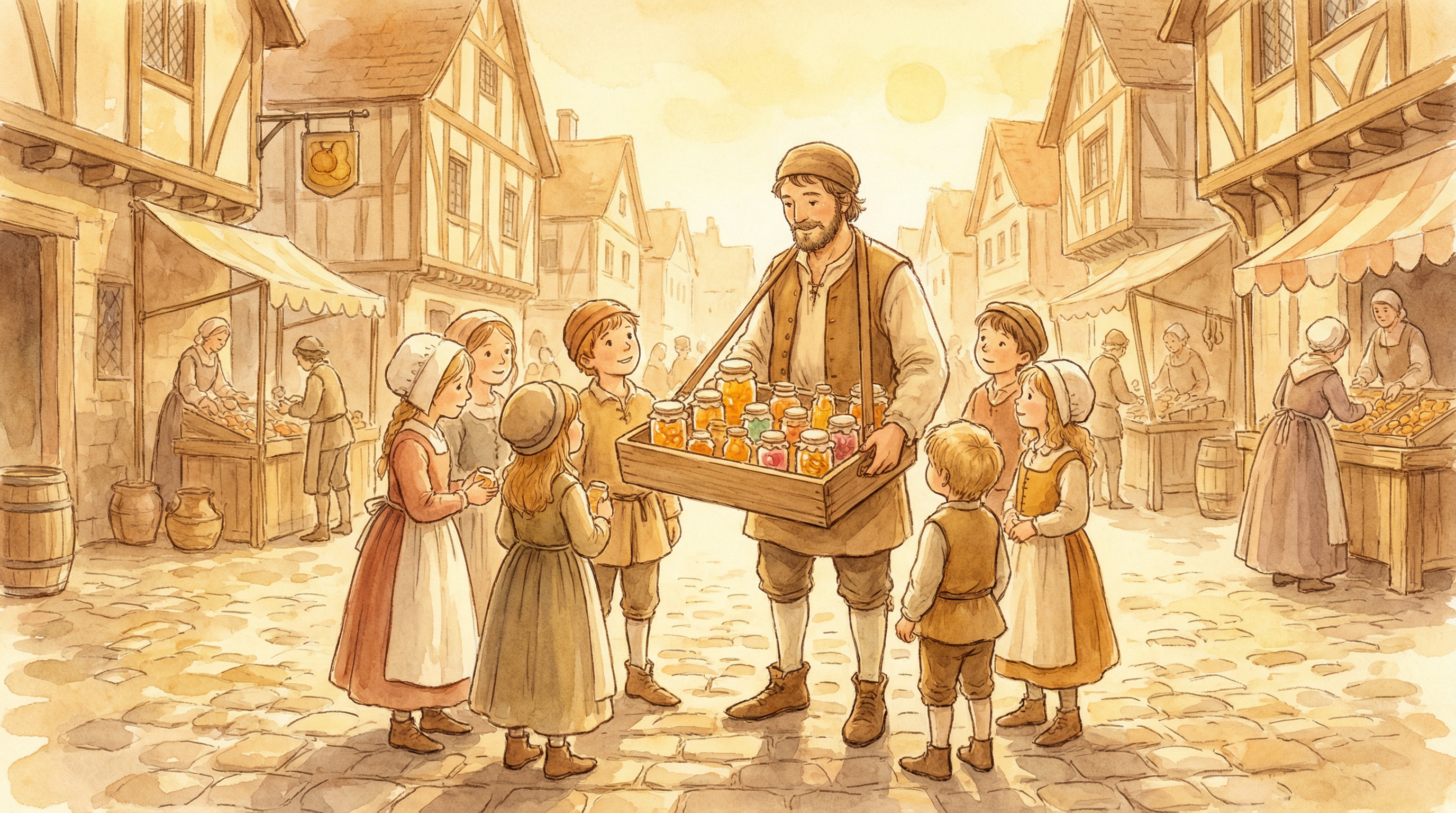
"Coulter's Candy" — sometimes known as "Ally Bally Bee" — is one of the most beloved of all Scottish children's songs, and the rare nursery rhyme with a firmly identified historical origin. It was written in the mid-nineteenth century by Robert Coltart (often anglicised to "Coulter"), a sweet-seller from the Borders town of Galashiels who sold a popular boiled sweet he called "Coulter's Candy."
Coltart apparently wrote the song himself as an advertisement for his confectionery — a primitive but brilliantly effective piece of marketing. The song invited children to ask their mothers for a "bawbee" (a small copper coin, worth half a penny) to spend on his sweets. Given that children proved enthusiastic singers of the advertisement, it worked.
The song is written in Scots — the West Germanic language distinct from both English and Scottish Gaelic that was spoken across much of Lowland Scotland — giving it an authentic regional character. The references to hard times ("father's signing on the broo," meaning claiming unemployment benefit) were added in later versions and reflect the economic hardships of the Depression era.
"Ally bally bee" is a Scots nonsense refrain with no fixed meaning beyond its musical function — it rolls off the tongue and establishes the song's gentle, rolling rhythm. The image of a child sitting on their mother's knee, crying for pennies, is both comically relatable and tenderly observed.
The song has been recorded by folk artists across Scotland for generations and remains a staple of Scottish childhood. It is one of those pieces of music inseparable from a particular landscape and people.