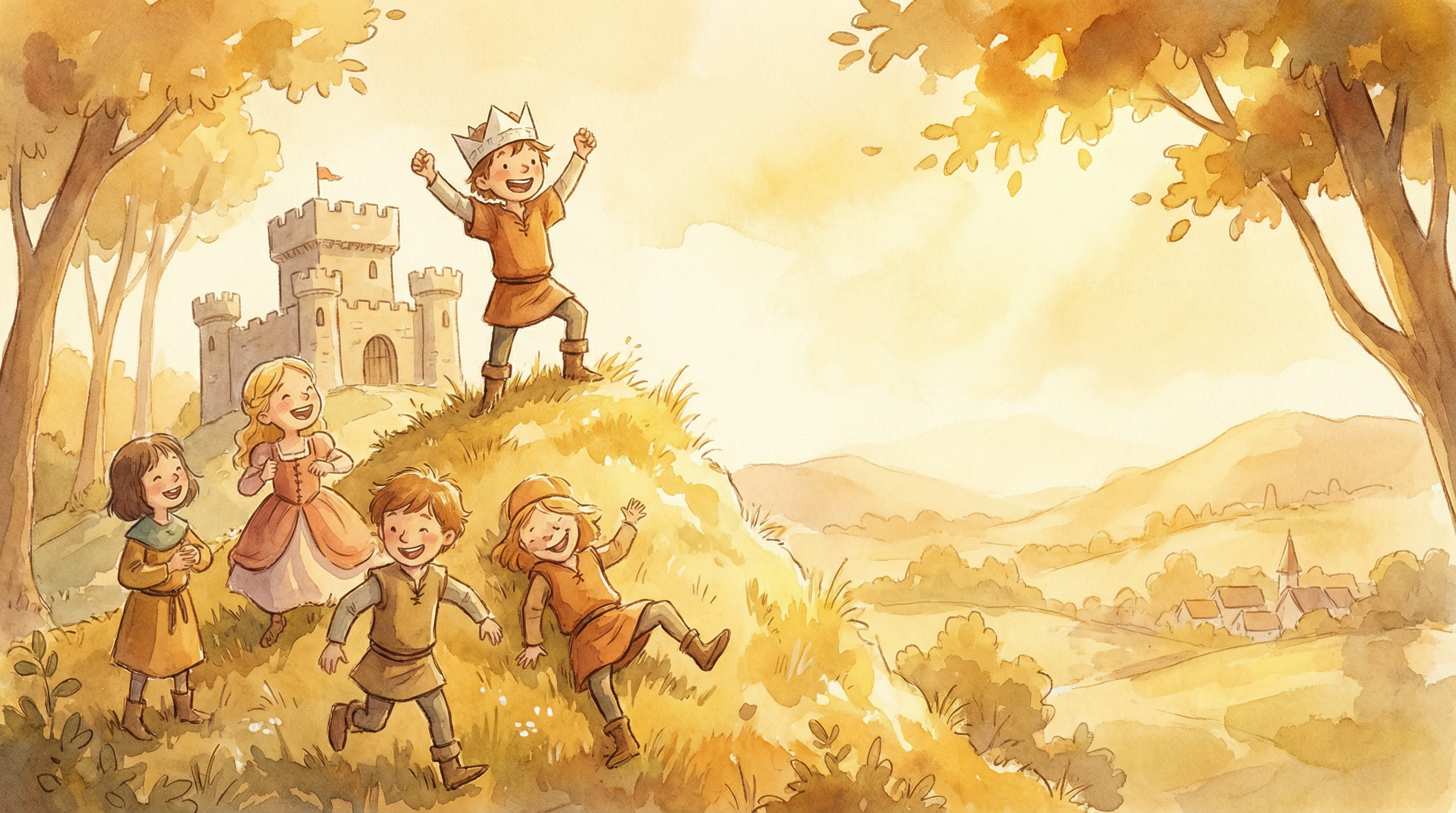
I'm the King of the Castle
Climb to the top and declare yourself ruler — until someone pushes you off
Listen
Arrangement: Ian J. Watts / Mike Wilbury · Singalongasong Band / ClassicRocks
Lyrics
I'm the king of the castle,
You're the dirty rascal!
I'm the king of the castle,
You're the dirty rascal!
I'm the king of the castle,
You're the dirty rascal!
Traditional lyrics — public domain. Arrangement © Singalongasong Band / ClassicRocks.
History & Background
History & Origin
"I'm the King of the Castle" is one of the oldest playground chants in the English tradition, its origins stretching back at least to the seventeenth century. It accompanies a game of the same name, in which one child stands on a raised surface — a wall, a mound, a pile of earth — and declares themselves king, while others attempt to climb up and displace them. The "dirty rascal" is whoever is trying to overthrow the current monarch.
The game is one of the purest expressions of playground hierarchy: physical dominance translated directly into a social declaration. The rhyme is deliberately taunting, designed to provoke rather than console. "Dirty rascal" is mild by the standards of modern playground insults, but it carries enough edge to make the game feel consequential.
Some commentators have linked the chant to medieval siege warfare — the idea of a castle that must be defended against attackers — though the chant is more plausibly understood as a universal game of territory and dominance that children invent and reinvent in every culture and era.
The rhyme itself is minimal almost to the point of non-existence as poetry: it is pure declaration, pure challenge, designed to be shouted rather than sung. Our arrangement gives it considerably more musical dressing than it has any right to expect.