Listen
Arrangement: Ian J. Watts / Mike Wilbury · Singalongasong Band / ClassicRocks
Lyrics
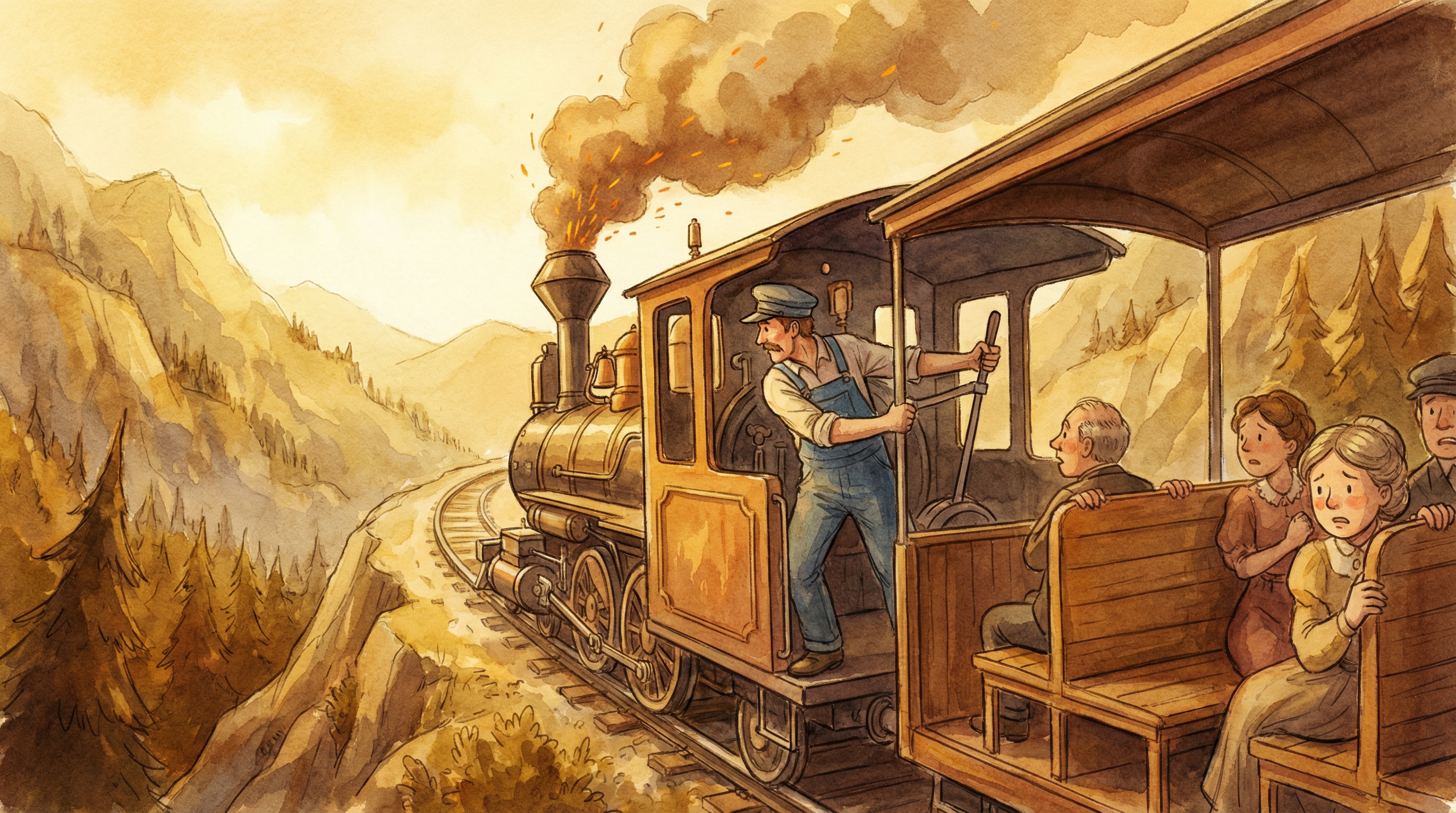
'Twas in the year of '89 on that old Great Western line,
When the winter wind was blowin' shrill.
The rails were froze, the winds were cold,
Then the air brakes wouldn't hold,
And Number 9 came roaring down the hill.
The runaway train came down the track and she blew,
The runaway train came down the track and she blew,
The runaway train came down the track,
Her whistle wide and her throttle back,
And she blew, blew, blew, blew, blew.
The engineer said the train must halt and she blew,
The engineer said the train must halt and she blew,
The engineer said the train must halt,
He said it was all the fireman's fault,
And she blew, blew, blew, blew, blew.
The fireman said he rang the bell and she blew,
The fireman said he rang the bell and she blew,
The fireman said he rang the bell,
The engineer said "he couldn't tell",
And she blew, blew, blew, blew, blew.
The porter got an awful fright and she blew,
The porter got an awful fright and she blew,
The porter got an awful fright,
He got so scared he went all white,
And she blew, blew, blew, blew, blew.
The conductor said there'd be a wreck and she blew,
The conductor said there'd be a wreck and she blew,
The conductor said there'd be a wreck,
And he felt the chills run down his neck,
And she blew, blew, blew, blew, blew.
The runaway train went over the hill and she blew,
The runaway train went over the hill and she blew,
The runaway train went over the hill,
And the last we heard she was going still,
And she blew, blew, blew, blew, blew.
Traditional lyrics — public domain. Arrangement © Singalongasong Band / ClassicRocks.
History & Background
History & Origin
"The Runaway Train" is a traditional American song whose origins lie in the tradition of disaster ballads — songs that tell the story of railway accidents, shipwrecks, and industrial catastrophes. The Great Western Railway line and "Number 9" suggest a specific incident, and similar songs about runaway trains proliferated in the late nineteenth and early twentieth centuries as the railways became both central to American life and a source of dramatic, newsworthy disasters.
The song is structured as a round of blame: the engineer blames the fireman, the fireman says he rang the bell, the engineer says he "couldn't tell", the porter goes white with fright, the conductor feels chills. Nobody stops the train. It goes over the hill and is presumably still going. The whistle is "wide" and the throttle "back" — the brakes have failed entirely — and the last we hear, she was going still.
The repeated "and she blew, blew, blew, blew, blew" is the sound of the train's whistle, a constant throughout the disaster, as if the train itself is announcing its own unstoppability. It is one of the most effective repeated sounds in any children's song — five "blews", each one louder in imagination than the last.
The song has been popular with children for generations, its combination of thrilling drama, comedy of incompetence, and the irresistible whistle making it one of the classics of the traditional repertoire.